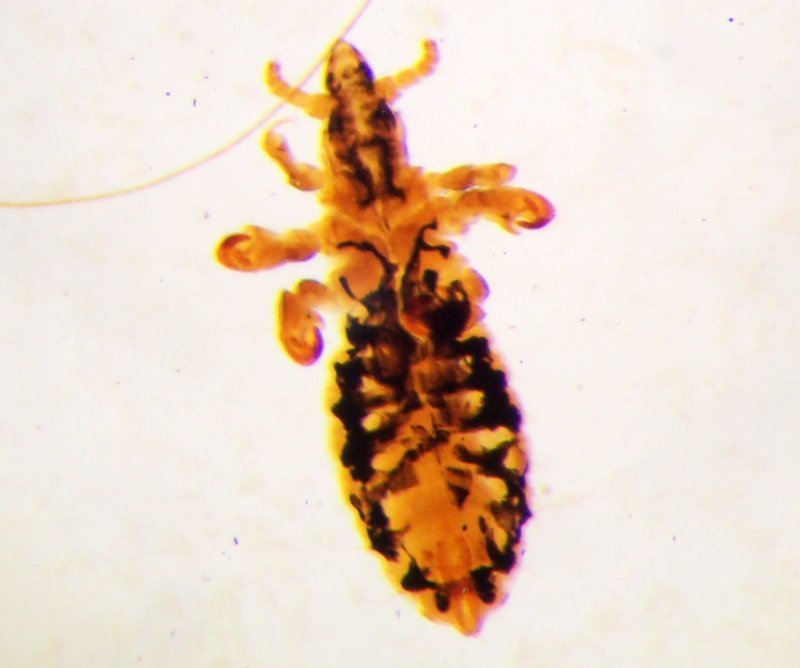
There are in two main groups of lice, biting lice and sucking lice.
Biting lice
Probably more accurately described as chewing lice, these are the most common type in Australia. They have tough chewing mouthparts on the underside of their head and mainly ‘graze’ on the surface of cattle, feeding on skin ‘scurf’ – dead skin cells, skin secretions and bacteria. They do not suck blood.
These lice feed on cattle blood and have fine stylets that they use to penetrate capillaries to feed. In large numbers these lice cause far greater production losses than biting lice.
The basic body plan of the two groups is different with biting lice having a broad brownish head, almost as wide as their body and sucking lice having a long narrow head, much narrower than the body (Figure 1 shows the different head types). The abdomen of adult sucking lice usually appears very dark brown or red-bluish in colour from blood in their guts. Biting lice have a broad brownish head and light cream bodies with darker brown transverse stripes on the abdomen of the adults (see Figures 2 and 3 below).
Figure 1. Cattle biting louse left and sucking louse right showing head types. Image credit Queensland Department of Agriculture and Fisheries farmnote F132.
Figure 3. Long nosed sucking louse adult Linognathus vituli. Image credit Peter James
Treating biting and sucking lice
The difference between the feeding habits of biting and sucking lice is important in deciding which types of products will be most effective in their control. Both sucking and biting lice can be effectively controlled by pour-on, spray or dipping products applied topically to cattle, as these treatments come into physical contact with the lice regardless of their type. However sucking lice, because they feed on blood, can also be controlled by macrocyclic lactone (ML) compounds applied by injection, whereas the injectable products are not as effective against biting lice because they do not ingest the blood which contains the injectable treatment. Where biting lice are present generally a spray, dipping or a pour-on treatment will be required for good control (see application methods).
Your feedback is important to us. Let us know how we could improve?
Notice: you are leaving the ParaBoss main website
www.wecqa.com.au is a secondary ParaBoss website hosted by the University of New England (UNE). Whilst this is still an official ParaBoss website, UNE is solely responsible for the website’s branding, content, offerings, and level of security. Please refer to the website’s posted Privacy Policy and Terms of Use.


 Tools
Tools